Anyone who has worked in early childhood education knows how much invisible analysis goes into a normal week. A center director compares enrollment forms with staffing ratios, a lead teacher notices that the afternoon pickup routine keeps breaking down, and an administrator rewrites a parent communication process for the third time because nobody agrees on who sends what. Those habits, listening carefully, mapping how work really happens and writing it down clearly, are exactly the habits that a business analyst uses every day. If you work in education or training and you are curious about a move into that kind of role, it helps to see what the job actually involves before you spend money on courses.
This article walks through the business analyst career guide published by Be Ready Education, what it says, what it leaves out, and who is likely to get the most from it.
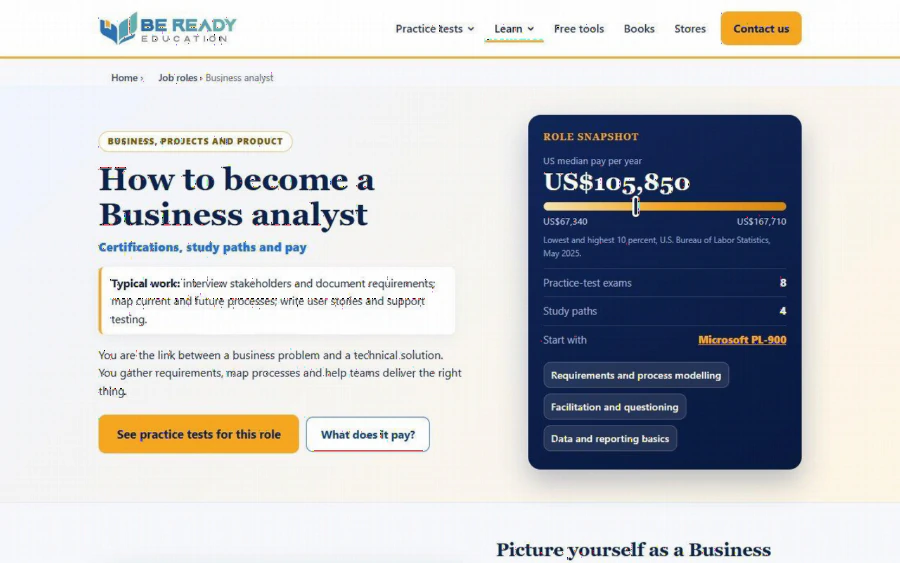
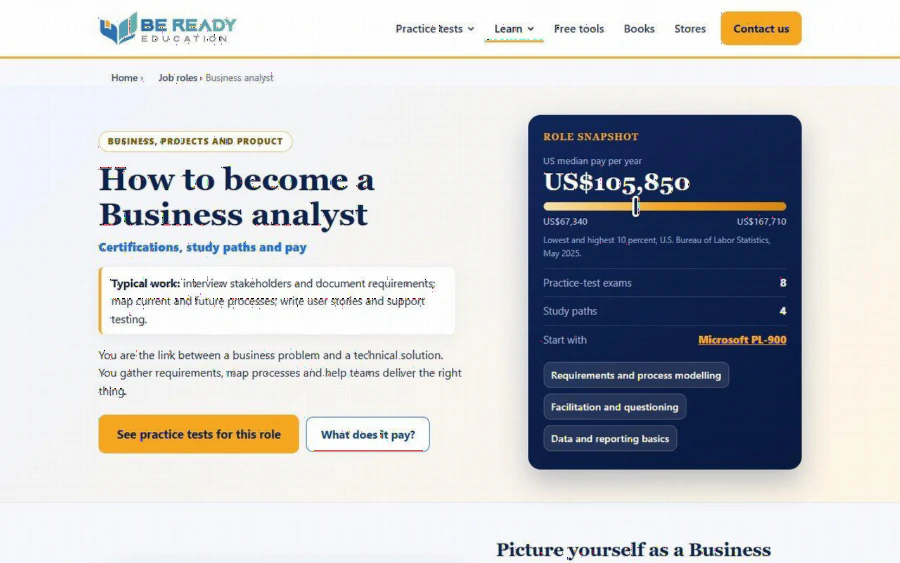
The top of the Be Ready Education page titled How to become a Business analyst, with the role snapshot card showing US median pay of US$105,850 and a suggested first exam
What the page tells you about the job
The page opens with a plain description of the role: a business analyst is the link between a business problem and a technical solution. The typical work it lists is interviewing stakeholders and documenting requirements, mapping current and future processes, writing user stories and supporting testing. That is a refreshingly concrete list.
The page also names the skills it considers central: requirements and process modelling, facilitation and questioning, data and reporting basics, and clear writing. Notice how few of those are about software. Facilitation and clear writing are things teachers practice constantly, which is why this role is a natural bridge for people coming out of education, training or program coordination.
It then lists the tools employers commonly use, and it is careful to say that employers vary. The list includes Jira or Azure DevOps, Confluence or similar documentation tools, Microsoft Visio or draw.io, Excel, SQL basics, Power BI or Tableau, and Miro or similar whiteboard tools. You do not need all of them on day one. Excel and a diagramming tool are a sensible place to start, and the rest can be learned once you know which workplace you are joining.
The pay figures, read honestly
Salary is usually the first thing people want to know, and this is a place where a guide can easily mislead. The Be Ready Education page cites the U.S. Bureau of Labor Statistics, May 2025, for United States pay: the lowest 10 percent earn under US$67,340, the median is US$105,850 per year, and the highest 10 percent earn over US$167,710. The page labels these as starting out, established, and senior or specialist, and it names what pushes pay upward: larger systems, teams or budgets, in-demand certifications, and moving into specialist, lead or manager tracks.
Two cautions are worth keeping in mind. First, the page itself says it does not split pay by years of experience, and that the figures are a guide, not an offer. Second, these are United States numbers. If you work in Australia, Vietnam or anywhere else, the local market will differ, and you should check local salary sources before making a decision. The guide is useful for understanding the shape of the range, not for predicting your own paycheck.
The first 90 days and the interview questions
One of the more practical parts of the page is the outline of the first 90 days. In the first month you learn the business area, meet stakeholders and read existing process and requirement documents. In months two and three you run workshops, write requirements or user stories, and map current and future processes. Throughout, you support testing and sign-off and flag gaps or risks early. The page adds that this is a typical pattern, not a rule, and that every employer onboards differently.
For education professionals this is reassuring: the first month is mostly listening and reading.
The page also lists five interview questions with notes on what a strong answer covers:
- How do you gather requirements from stakeholders who disagree? A strong answer listens to each view, finds the underlying goals, uses facts and facilitation, and escalates decisions appropriately.
- How would you map a business process? Talk to the people doing the work, draw the steps and decisions, validate with them and identify pain points.
- What makes a good user story? Name who needs it, what they need and why, with acceptance criteria a tester can check.
- How do you handle a request that changes midway through a project? Assess the impact on scope, time and cost, consult the right people and record the decision.
- Tell me about a time your analysis changed a decision. Describe the finding, present the evidence clearly and explain how stakeholders responded.
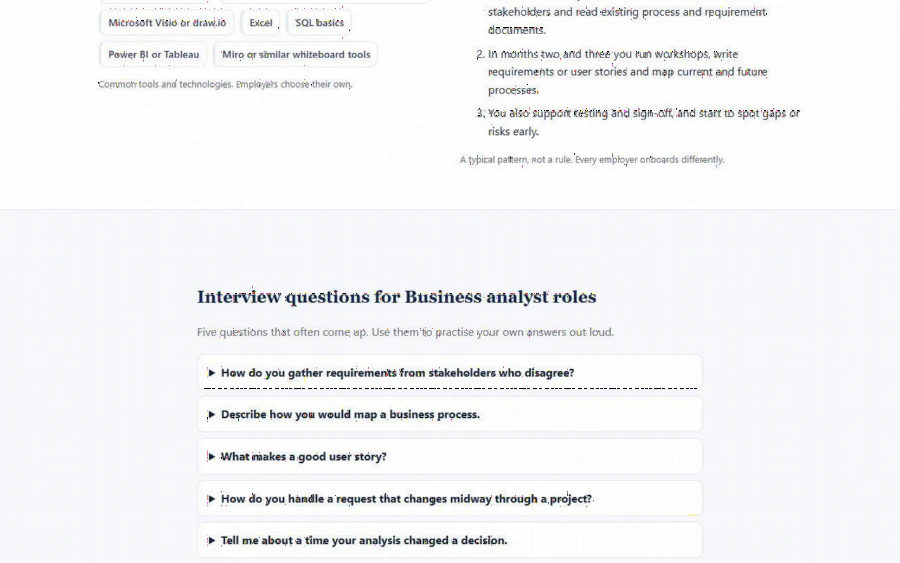
The interview questions section of the Be Ready Education business analyst page, listing five common questions as expandable items
The questions about disagreeing stakeholders and mid-project change are where candidates from non-technical backgrounds often have real stories to tell, even if they come from a school or childcare setting.
An illustration: a center coordinator thinking about a change
To make this concrete, here is an illustrative scenario, not a real customer story. Imagine a coordinator at a busy preschool who spends most of her week untangling enrollment paperwork, waitlist updates and parent messages across three different spreadsheets. She starts documenting the steps, asks staff where delays happen, and proposes a single intake form with clear fields. That small project involves gathering requirements, mapping a current and a future process and getting sign-off from a director who has different priorities from the teachers. In other words, it is a miniature business analysis exercise.
If she wanted to turn that experience into a job title, the page gives her a way to start: read the role overview, check the skills list against what she has already done, and look at the practice tests the site recommends for the role. The suggested first exam is Microsoft PL-900, a fundamentals-level exam. The page lists eight practice-test exams for the role in total, and four study paths. That gives a newcomer a sequence rather than a wall of options.
The practice tests and what they cover
The role page includes a table of practice-test sets linked to business analysis. Based on the page, the list includes Microsoft PL-900 (Fundamentals, 5 tests, 250 questions), Oracle OCI AI Foundations (Foundational, 5 tests, 200 questions), PMI-CPMAI (Professional, 5 tests, 600 questions), Microsoft AI-901 (Fundamentals, 5 tests, 225 questions), CompTIA Data+ (Intermediate, 5 tests, 450 questions), Google Cloud Generative AI Leader (Foundational, 5 tests, 300 questions), Microsoft AB-730 (Fundamentals, 5 tests, 250 questions) and CAPM (Entry level, 5 tests, 750 questions).
The mix covers a Microsoft platform entry point, data skills, project management and several AI foundations exams, which reflects analysts increasingly working on data and AI projects. The page also lists related job titles, such as business systems analyst, process improvement analyst, digital transformation analyst and a business analyst on AI projects, and related roles like project coordinator and data analyst.
If you want to see how this fits with the rest of the catalogue, the other role pages on the site show neighboring careers side by side.
Strengths, limits and who should use it
The strengths of the page are clear. It is specific about daily work, honest about its pay sources and connects the role to concrete study steps instead of leaving you to guess.
There are limits too. The page lists no exam fees, course prices or subscription costs, so you will need to check vendor sites for what each certification costs. The pay figures are for the United States only. It also shows a few unlabelled numbers beside the study paths that it does not explain, so treat those as decoration rather than data. And no practice-test set can replace real experience: certifications are a signal, but employers hiring analysts also want to hear how you handled a real disagreement or a real process problem.
This guide suits teachers, trainers, program coordinators and administrators who already do analysis informally and want a structured picture of the career. It suits people deciding between several office-based roles and wanting to compare them. It is less suited to someone who wants a guaranteed job outcome or a detailed salary forecast for a specific country, because the page does not claim to offer either.
How to get started this week
You can start without paying for anything. Read the role page and highlight the skills you already use. Write down three real examples from your current job where you gathered requirements, mapped a process or resolved a disagreement between people who wanted different things. Practice the five interview questions out loud using those examples. Then decide whether you want to try the suggested first exam, Microsoft PL-900, to test your interest in technology platforms before committing to a longer study path.
If the work still sounds appealing, you will have interview stories and a sense of which tools to learn first. If not, you have lost nothing and learned something about your next step.